Representation Fatigue
“And I don’t want the world to see me
’Cause I don’t think that they’d understand
When everything’s made to be broken
I just want you to know who I am”
This is not a post about trains.
I was due to write about representation fatigue this week, when this happened and I felt desperate to get it down. Writing about the challenges of travelling whilst disabled when it happens is important, and this particular incident felt so revelatory of two things.
Firstly, the way these situations can feel, in light of all the variables, which is often so hard to describe to the folks who have never experienced them from where I sit. Secondly, the way in which it is no human being's fault.
So I thought I'd skip writing about representation fatigue, and write about this instead. But then, as I wrote, I realized that they were the same post.
What follows is not just an account of a disrupted journey, but an account of the cumulative labour of being perceived, interpreted, and judged whilst trying to get home. It's a post that interweaves narrative and reflection in four sections where I tell the story of a journey and then name the cost.
TLDR? This is a post about representation fatigue.
If you get tired reading it, imagine living it.
The cost of (in)visibility
“I don’t want the world to see me...”
16:40: I'm leaving work. It should be around a ten minute roll to King's cross station. I have to leave forty minutes before my train because: a) I am supposed to be twenty minutes early to meet my pre-booked passenger assistance. If I'm late, they sometimes say I can't get the train, even though I know I could get there on time. b) People often cut in front of me when I'm trying to roll to the station. Cars frequently ignore the lights and stop over the dropped curb. So it could take ten minutes or it could take thirty. I can work for the hour that I'm on the train, so it's all good.
17:06: I get to the station. It took twenty six minutes, more than double time. A group of people with suitcases ran to undertake me, only for me to spend the next bit of pavement crawling behind them, wearing out my gloves and my hands, desperate to overtake whilst they slowly wandered and chatted. Other pedestrians overtook them and me, causing me to constantly need to break suddenly and swerve wildly. Thankfully I managed to not accidentally hit anyone or swear.
I don't get to stop being a wheelchair user when it's inconvenient for me. I don't get to be invisible, or hide from people's reactions or ignore their actions. So I leave early, I strive to be on time, I rush when I can, I take care when I must. I mustn't shout, or swear, or mess up - I don't want the world to see me - how I act will impact the next wheelchair user they see. I must be patient, generous, forgiving, kind. I'm late anyway, I often am. I can't control other people's actions. I have to accept that I'm not always an early person any more, shed that part of my identity. I have to concentrate on getting there safely.
The cost of assumptions
“‘Cause I don’t think that they’d understand...”
17.08: I go to the assistance desk. They should take me through the assistance lounge to the platform. Instead they calmly instruct me to fight back through the crowds to platform 8. Someone will meet me there. "Fair enough", I think, "they are probably very busy".
17:10: I get to the platform. Thankfully, Naomi (not her real name) is there. She's a member of the passenger assist team who helps me regularly. I start a conversation about her Christmas holidays. The train pulls in. A few moments later, the driver strides past. Naomi chases after him. I hear him tell her that the train isn't running. There hasn't been an announcement yet. I don't know what's going on. Naomi comes back and says she will stay with me until this gets sorted.
17:18: My train is scheduled. The next ten minutes or so are chaotic. There are several loud announcements telling customers to go to a different station, get a different train. Naomi knows I can't. We wait. Every few moments, more chaos pours in through her walkie-talkie. I can hear bits of what they say. No-one is quite sure what is happening, what will run, where it will run from, what the plan is. Several passengers speak to Naomi loudly and rudely. I apologize to her for the fact that she is treated this way. She pats me on the arm. I'm starting to become overwhelmed by the noise and the uncertainty.
I am ridiculously thankful for Naomi. People are constantly reminding me to practice gratitude. As a wheelchair user, I can't help feeling immense gratitude whenever someone seems to 'get it', and listens, and helps, and treats me like a human being. It's not hard to find at least one thing to be thankful for every day. But gratitude is part of representation fatigue. We are expected to feel grateful for the crumbs under the table. Naomi is exceptional, but she shouldn't be. She's simply kind. Is gratitude real if your thanks is for less than you deserve - than any human being deserves?
The thing is, the system is broken. Naomi and I both know it, and both rely on the fragments that are left. We are both overwhelmed. We are both trying our best. We are both at the mercy of both the system and the people who are angry at it. They have the privilege to be angry. If I am angry, it will perpetuate several stereotypes all at once. Naomi too, albeit for different reasons, different lived experiences, different characteristics than mine. As customers shout, Naomi remains professional and kind. Sometimes representation fatigue is related to the constant tone policing that echoes in one’s own mind.
The cost of broken systems
“When everything’s made to be broken...”
17:25: I try to make a new plan. Look at the map. The National Rail app. I could go to St. Neots. It's nowhere near my original destination. Naomi isn't convinced. The reality is that I will go wherever they put me on a train to - I don't really have any choice. I try to keep in touch with my wife, my friends. The plans for this evening will have to change. I'm tired and stressed, and sensory overwhelm plus the pressure of being a 'good crip' is pushing me towards meltdown.
17:32: Naomi gets a message that the next train to my station is coming in on a different platform. I can't remember where that platform is. I look at her helplessly. Understanding, she takes me through the passenger assist lounge and to the platform. She hands me over to someone else - she has to manage the next case. I will miss her. None of this is her fault, and she is the only member of staff in the station I trust to get me safely on to a train home.
17:45: The train is here. No one knows if it's actually the right train. People keep coming to ask. I overhear that the team are trying to board me before the platform is announced. I know that is impossible but think, "bless them for trying". A group of train watchers show up and excitedly fire questions at the person assisting me. After a few moments he suddenly announces that his colleague will come and help me and disappears.
18:00: People start getting on the train. Is it the right one? It's not on the app. It's not on the screens. I can't see any staff members. I'm getting very cold. People rush past me in every direction. Two men with suitcases park themselves either side of me. Now I can't see anything. I ask them to move, very politely, repeatedly. They have headphones in. They can't hear me. A train watcher catches my eye and laughs. I'm right in the draft from the tunnel. I'm freezing.
18:06: Another member of staff shows up. "Hurry", he says, "It's this one". He puts the ramp down. There are people everywhere. The end of the ramp is inches away from a pole. I manage to get on to the ramp but, with no run up, can't make the gradient. I ask for help. I ask three times before he hears - bombarded as he is by questions from other passengers, I almost slide backwards, but he grabs my handles just in time.
As a disabled customer, I often try to think for myself, to find other ways to get home, to rearrange my plans. I'm aware that everyone else has to do this too. The problem is, I have to do this whilst being restricted by the need for assistance, which removes my autonomy. Ultimately, to the system, I'm not a person, I'm a wheelchair that needs to get to the destination station on my ticket. As a result, my helpful suggestions (such as going to St. Neots) are often ignored. If I had been allowed me the autonomy to get on the train to St. Neots I would have arrived at 6.30pm, more than halving the length of this post. In short, blame the system. Perhaps I should have shouted, or insisted, but trying to balance everything going on, and not leave an impression that will effect the next disabled passenger, makes this feel impossible.
Finding allies like Naomi is a vital part of being a subaltern person, someone who is seen as other. Balancing the need to keep allies 'on side' and the need to campaign for systemic change is really tricky. The employees who tried to pre-warn me about the train were allies too. Often good people, allies, try to buck the system. This leads, as the person representing the protected characteristic of disability, to an odd mix of emotions. Pride - because they get it, which suggests the explanation work has landed somewhere. Fear - because if an angry passenger overhears that I am being prioritised, I'm going to be bang smack in the middle of a culture war front line. Shame - because, like many subaltern people, I feel guilty when I get equitable treatment and then feel ashamed because I know that that guilt is a result of repression formed by living in a normative society. Hope - because maybe the allies' attempts to help will work. Resignation - because I suspect they will not, based on long experience.
There are points in this part of the journey when I'm completely alone. People only notice the representation of a protected characteristic when they are physically with them. They don't realise that, when alone, we are still often in a difficult and potentially painful situation. Those moments are for us to just get through. This bit of the story is inconvenient, but it’s also standard. I have to accept that people quite simply cannot experience life through my body. They don't know that during train delays wheelchair users can get exceptionally cold due to being stationary on exposed platforms for extended amount of times, and certainly don't know how painful and/or dangerous that can be. They don't know that if they stand close to me it blocks my low sight line entirely. They don't know that I could really use help right now. The reality is that I was once the person texting whilst walking and ignoring people with my headphones on. I didn't know what I know now.
The cost of poor communication
“I just want you to know who I am...”
You just read about the moment that the chance of any autonomy disappears out the window. I still don't actually know the destination of the train that I'm getting on, but I also know that if I don't get on a) I could be waiting another hour and b) this guy is likely to be seriously annoyed with me.
18:10: I'm sat on the train. It's getting busier and busier. Someone's backpack is in my face. When he moves as more people come on, I have to lean far to the left so that it doesn't hit me. The leaning hurts and I don't feel entirely stable. I ask him to move, he's not happy about it. Another passenger steps in to support me. Backpack guy moves grumpily.
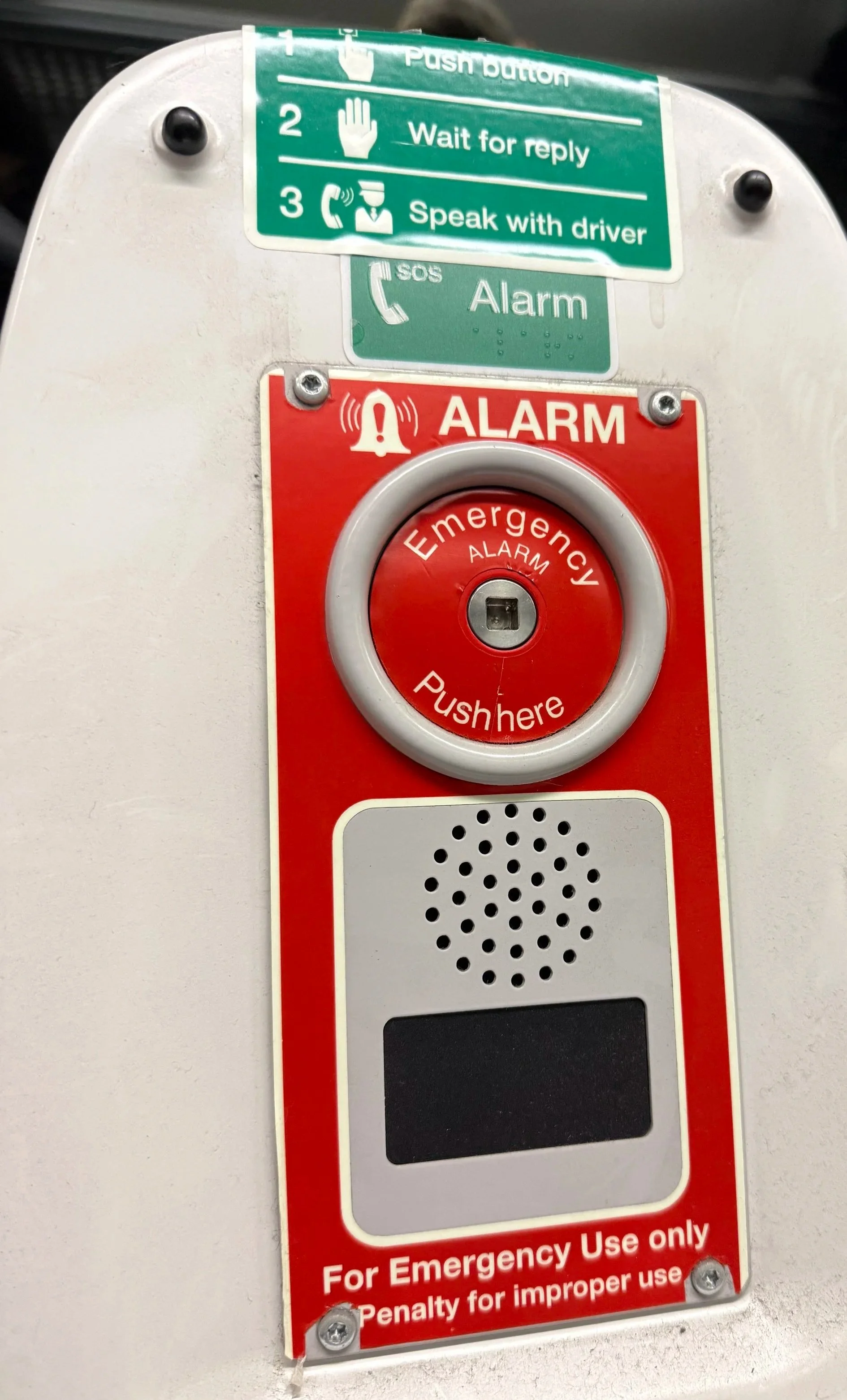
18:14: The train is moving. I wonder if the passenger assist team member remembered to call my home station and let them know that I am coming. If they don't, I will have to sit in the doors to keep them open and shout down to passengers on the platform until someone helps me. I really don't like doing that. It is embarrassing, and I'm worried that one day the sensors will fail and the doors will try to shut anyway. If no-one from the station comes to help, I have to ask the passenger nearest the alarm to push it. It's what we are supposed to do. It’s the only mode of contact we have with any form of assistance when on the train. Then the driver will come and sort it out, phoning the station, but they usually aren't best pleased. I just hope it doesn't end up terminating somewhere random. Once I'm on the train, I have no reliable contact with passenger assistance, so there's little I can do if that happens. I can't work, I'm too stressed, and this later service doesn't have wifi anyway. I might as well write.
18:29: I'm still sat on the train. Every time we turn, there is a loud screeching noise. It's someone's metal suitcase in the aisle. I try not to cry. I finish writing my account of what's happened this evening and say a quick prayer that I will be able to get off at the right station. My wife is claiming delay repay as I type. What is £24 worth?
The backpack moment leads to a long conversation with the person who helped about my disability, my experience of getting trains, the problems with the system, how lovely it is that there is a system (his words not mine), and what my care needs are (I refuse to answer that one). This is where representation fatigue really kicks in. By this point I have had almost an hour and a half of navigating a tricky situation made a lot trickier due to ableism. At this point in most people's train delay story, they are taking a deep breath and doing whatever it is they do whilst on the train. I'm having a very personal conversation that I didn't ask for whilst still wondering if I'm actually going to get home safely. I have witnessed a wheelchair user simply put his headphones in and ignore intrusive questioning. I was impressed. I'm not sure that I could do that.The customer alarm system, so necessary for actually being able to get off of the train when forgotten, acts as a reminder that subaltern people often have to do things that other people don't like whether we want to or not. They are often a designed part of the system, albeit a design aspect that is seen as 'inconvenient but necessary'. Sometimes, we actually do break the rules. Often that, too, is necessary, for our safety. Another part of representation fatigue comes from always being seen as difficult, when one is simply trying to survive. That's one of the reasons why, for me, writing feels important and soothing in situations like this. It's an opportunity to explain what is actually going on, as opposed to how my experience may appear to another person.
There's often recompense available for inconveniences, but it rarely meets the actual costs of systemic failure for a disabled person. I'm certainly not getting rich out of PIP, as many assume. Delay repay covers the cost of the ticket but not the cost of managing to eat, sleep, and work which is multiplied many times by situations like this, nor the additional costs of physio, pain therapy, and chair repairs that often result from train delays and resulting incidents. This particular incident led to an estimated net loss of around £68. It's often much, much worse.
An update 19:56: I'm still on the train. It's been delayed well over an hour. We’ve stopped at the stop before mine. The driver keeps coming on the intercom to tell us that he’s ’arguing with control’ to ask them to continue the service onwards. Outside, someone starts shouting at platform staff, making threats. It doesn’t entirely help the overwhelm. I have almost been ‘offloaded’ three times. Each time the plan changes. Maybe I will get home soon. The journey towards justice will be much longer. The system is broken. Some days, it's exhausting.
20:23: As I get off the train I tell the passenger assist team member - who I know well by now - how glad I am to see him. He says he is glad to see me too, and that he's been alternately phoning stations and control to try to work out where I am and make sure they don't miss me. Gratitude is back.
Representation Fatigue
Representation fatigue is the feeling of exhaustion and isolation that occurs when living with a particular subaltern (othered) identity, particularly when you are held up as exemplar of that identity. It's important to remember that all people who are treated as representatives are in fact individuals, each with our own distinct experiences and interpretations of an event.
After all of this, it seems strange to try to create a neat ending, but also vital to use the tools we have to work towards understanding and change. In the above exploration of a real situation that I experienced this week, I have touched on many aspects of representation fatigue. It is likely that many people with subaltern identity characteristics also experience some or all of these. I certainly have experienced each of these aspects of representation fatigue in relation to being trans, too, though I use my status as a disabled person as the grounding of this post. I list these characteristics below, together with ways you can help.
Constancy (i.e. you can't stop being [insert characteristic here]).
It may sound obvious, but treat people like people. If every single time you talk to your disabled friend, you talk about the fact that they are disabled (switch disabled here for any characteristic), that contributes to representative fatigue and may also effect your friendship.
Loss of parts of your broader identity.
Support the rights of subaltern people to live a full life, by campaigning for full access to all public, third sector and commercial spaces for people who are marginalised.
A lack of public/system understanding of your lived reality, including an inability of the system to protect you from risk/harm.
Learn and teach people and systems about the experiences of subaltern people. If you are a part of a system, then you can also be a part of changing it. Every single human being is a part of at least one system.
Complex (and sometimes impelled) gratitude.
Don't expect people to be grateful for small mercies. When something is rubbish, empathise with that; don't skip over it in search of the good.
Internal and external tone policing.
When you don't like someone's tone, pause and consider why they might be speaking or writing in that way in light of what they experience on a daily basis.
The awareness of the effects of your actions on a large set of people who hold a similar identity characteristic.
Assume that each person is experiencing, thinking, speaking and acting for themselves, not for every person they share a characteristic with. It's great to learn from people with lived experience, but even better to learn from a wide range of people with lived experience than only one person.
The task of forming and maintaining allies.
If you know someone who might need an ally do ask what you can do to be one; don't assume you know the answer.
The balance of campaigning for change and making life livable, and the pressure of assumptive activist status.
Not every subaltern person is an activist. Don’t assume they are. And even if they are, recognise that they are also a human being who a) deserves to be able to switch off from time to time and b) will have their own set of opinions that are not identical to the opinions of any given social movement.
The balance of hope and despair.
Help create a society where hope can flourish.
This is a post about representation fatigue. If you got this far, thank-you for being in the struggle with me.